Cabudare Kids
The two Koreas
One people, split into two countries with different rules. A true story, with a photo taken from space.
The story
Hi! I'm Cardi. Today I'll tell you the story of a people that was split into two countries.
Imagine two cousins, Ji-ho and Mina, who played together in Korea in 1945. They had the same language, the same food and the same songs.
In 1945, at the end of a big world war, Korea was divided in two: the North and the South.
Ji-ho ended up in the North and Mina in the South. Then came another war. It ended in 1953 with an agreement to stop fighting. But peace between the two is still fragile.
Each side chose different rules.
In the North, communism: the government controls the economy and there are no free elections.
In the South, people can own businesses, buy and sell (a market economy). And since 1987 they choose their leaders (democracy).
At first, both sides were very poor. In 1960, the South produced only about 159 dollars per person for the whole year. That's in the dollars of that time.
And an honest fact: in 1960 people in the North lived a little longer, on average, than people in the South. It was almost 56 years against almost 54.
Years went by. Today people in the South live almost 84 years on average; in the North, almost 74.
The South's central bank made a calculation. By its calculation, someone in the North earns about 29 times less, on average, than someone in the South. It's an estimate, not an exact count.
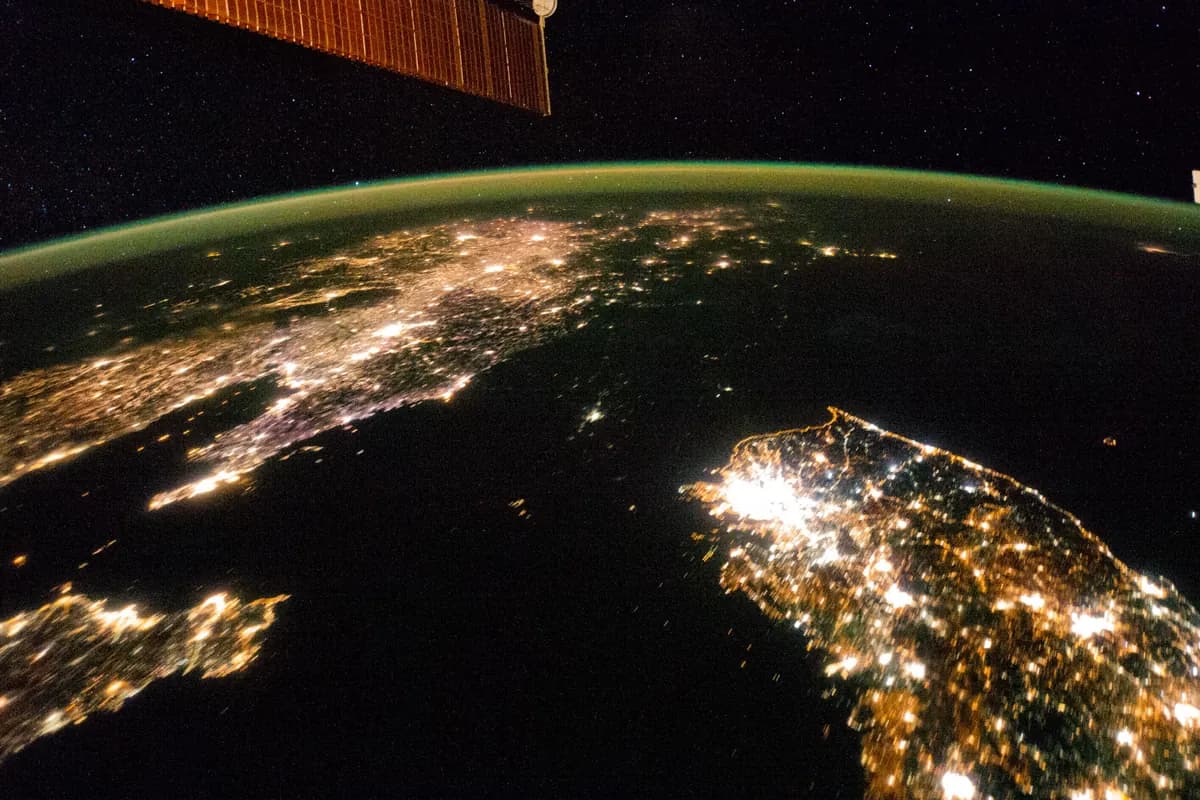
Photo: NASA/ISS Crew Earth Observations, ISS038-E-38300 In 2014, astronauts took this night photo from the International Space Station.
The South shines with lights. The North is almost completely dark.
According to NASA, each person in the South uses almost 14 times more electricity than a person in the North.
In the 1990s, the North had a famine. There was far too little food, and a great many people died of hunger.
Today, people in the North can't choose their leaders, say what they think or leave the country.
There is an organization that measures freedom around the world. It gives the North 3 points out of 100, and the South 83.
Ji-ho and Mina were the same people, with the same history. What changed were the rules.
The people of the North are not to blame: they are the ones who have suffered most under those rules.
Many families dream of hugging each other again one day. When people can choose and speak, they can fix their mistakes.
What did you learn?
- Same people, same history: different rules led to very different lives.
- When nobody can complain or vote, a government's mistakes don't get fixed.
- Telling the whole truth includes the facts we didn't expect. For example, in 1960 people in the North lived a little longer.
This really happened
This is where we checked every fact in the story:
- 1.Encyclopaedia Britannica, Korean War, accessed September 28, 2026.
- 2.Encyclopaedia Britannica, South Korea: The Sixth Republic, accessed September 28, 2026.
- 3.Banco Mundial, GDP per capita (current US$) - Korea, Rep., accessed September 28, 2026.
- 4.Banco Mundial, Life expectancy at birth, total (years) - Korea, Rep.; Korea, Dem. People's Rep., accessed September 28, 2026.
- 5.Yonhap Infomax, North Korea's GDP Grew 3.7% Last Year—Per Capita GNI at 1.72 Million Won, Aug 29, 2025.
- 6.NASA Earth Observatory, The Koreas at Night, Feb 24, 2014.
- 7.Peterson Institute for International Economics (S. Haggard and M. Noland), Famine in North Korea: Markets, Aid, and Reform, 2007.
- 8.Freedom House, North Korea: Freedom in the World 2026 Country Report, 2026.
- 9.Freedom House, South Korea: Freedom in the World 2026 Country Report, 2026.
For grown-ups: notes and links to sources
For grown-ups: Ji-ho and Mina are made up; the facts are not. The North's income is a Bank of Korea estimate (1.72 million won per person in 2024, 3.4% of the South's). On deaths in the 1990s famine, a PIIE study speaks of as many as one million.
- 1.Encyclopaedia Britannica · britannica.com (opens another site)
- 2.Encyclopaedia Britannica · britannica.com (opens another site)
- 3.Banco Mundial · data.worldbank.org (opens another site)
- 4.Banco Mundial · data.worldbank.org (opens another site)
- 5.Yonhap Infomax · en.infomaxai.com (opens another site)
- 6.NASA Earth Observatory · science.nasa.gov (opens another site)
- 7.Peterson Institute for International Economics (S. Haggard and M. Noland) · piie.com (opens another site)
- 8.Freedom House · freedomhouse.org (opens another site)
- 9.Freedom House · freedomhouse.org (opens another site)